

Two values of mine here in these weekly posts is that I be brutally brass tacks and that I write as if we were grabbing a meal or a beer together. I don’t really have the time to do anything else. Hence, I am going to pack a lot of information into this short piece.
I have had hundreds of conversations on AI uses over the last year and a lot of those are with pastors and ministry leaders. These are three of the most helpful word pictures from those conversations where I have seen the most lightbulbs turn on.
Every person must develop rules for themselves about when they will and when they will not use generative AI (these are things like LLMs like GPT, Gemini, and Claude, hereby, simply “AI). Maybe these three distinctions can have some heuristic value:
1. Toil vs. Labor
There are two kinds of work - toil and labor:
Toil is a work that is a direct result of the Fall.
Labor is work that is a direct result of the creation/cultural mandate.
I like the usage of “toil” as a translation of the Hebrew word, Amal (עָמָל) used frequently in Ecclesiastes. It connotes some of the mundane, meaningless, burdensome, thorny, and broken aspects of work. AI is often pretty good at this type of work and requires less wisdom in using in these situations.
Labor is best understood as the type of work outlined in Genesis 1:26-28:
26 Then God said, “Let us make man in our image, after our likeness. And let them have dominion over the fish of the sea and over the birds of the heavens and over the livestock and over all the earth and over every creeping thing that creeps on the earth.” 27 So God created man in his own image, in the image of God he created him; male and female he created them. 28 And God blessed them. And God said to them, “Be fruitful and multiply and fill the earth and subdue it, and have dominion over the fish of the sea and over the birds of the heavens and over every living thing that moves on the earth.”
I am broadly inclined to use AI for toil and I am broadly reluctant to use generative AI for labor. The reasons why are in point 2.
NOTE - this distinction is my adaptation from things that Andy Crouch has written about. So, if you like this distinction, credit Andy for his brilliance. These are rough sketches here and not meant to be ultra fleshed out exegetically.
2. Knowledge vs. Wisdom
I will often use AI for knowledge but never use it for wisdom - let me explain.
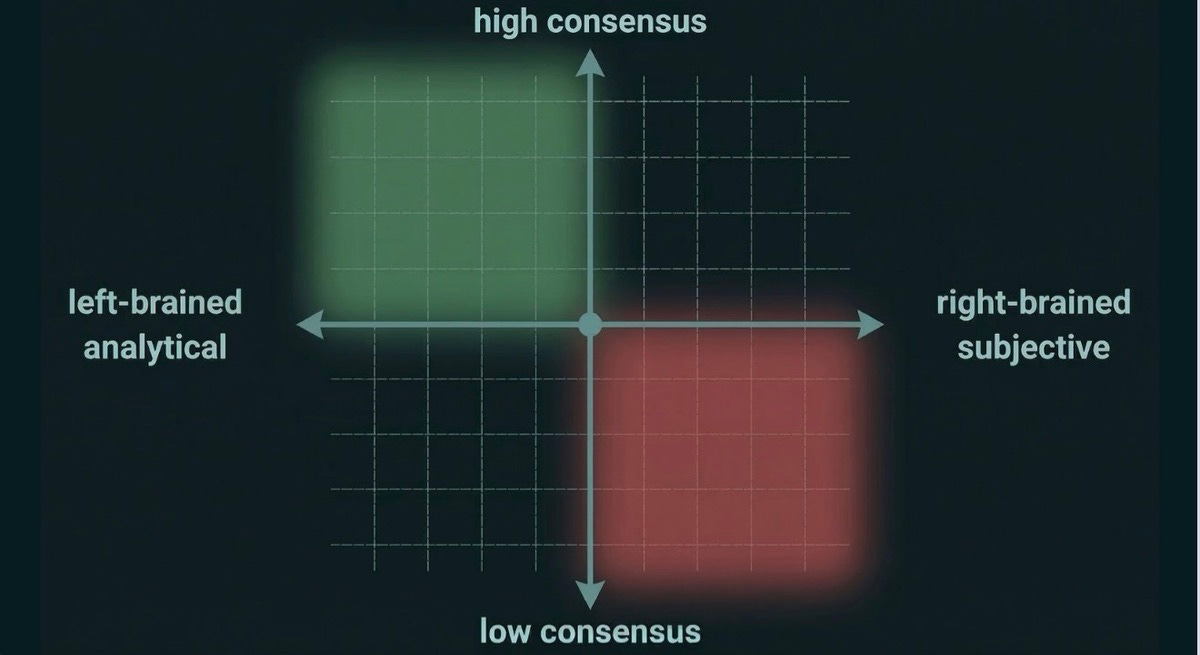
AI can be quite good at knowledge based questions, especially when you apply good prompt engineering skills. It is especially good in the upper left quadrant here of things that tend to be analytical and high consensus like coding, data extraction, and financial auditing. It is not as strong on things in the bottom right quadrant that are more subjective and are lower consensus like poetry, aestethics, or ethics:
When I am using AI in a ministry setting for knowledge based questions you will need to add guardrails to your prompts like:
“And make your answer consistent with The Gospel Coalition’s Foundation Documents and the New City Catechism”
I am fine and would encourage using AI for things that help you get back into human generated primary source content. So, I am good with prompts like this one:
“I am preaching on Ecclesiastes 5 and want some exegetical words studies on Amal (עָמָל) and Hevel (הֶבֶל) from a reformed Protestant perspective, please suggest several commentaries or resources I should look at.”
The same principle applies here outside of ministry or church contexts. These tools can be incredible on the knowledge side of things, especially on matters in the green quadrant.
I don’t ever use AI for things that require wisdom. I will write at more length on this in future weeks, but right now this is merely a sketch. In my view, wisdom requires embodiment, experiences, and image bearing. We acquire wisdom from things like prayer, the reading of Scripture, the reading of books authored by humans, and conversations with other humans.
AI might be able to point me to some books, parts of Scripture, or people who possess wisdom but I am not looking to generative AI to give me wisdom directly. I am also not saying that generative AI cannot say things that accord with wisdom. What I am saying is that any wisdom that comes from generative AI is because it has approximated wise things from embodied or sacred sources and we are much better served by just going directly to those embodied or sacred sources and skip the middleman when it comes to wisdom.
It is easy for knowledge based work to slip into wisdom work. You have to be careful there.
3. Tool vs. Prosthetic
Generative AI is best used as a tool and less as a prosthetic.
AI as a tool - You are operating a machine to complete a task. You create the intent and verify the output.
AI as a prosthetic - AI is functioning like a part of your person and replacing some type of function.
I am inclined to broadly use AI as a tool and less inclined to use it as a prosthetic. The only use cases where I am using AI to do things that I would normally do myself are things that incline themselves to automation that are toil-centric oriented. This would be things that only require knowledge but not wisdom such as the creation of custom dashboards or niche CRMs.
NOTE - This distinction is from John Dyer at Dallas Theological Seminary.
Hopefully these three distinctions help your personal decision tree on when to use AI and when not to.
WHAT HAPPENED IN RELIGION AND AI THIS WEEK:
The White House signed a new executive order meant to balance innovation and security (NYT writeup here)
Yuval Levin has what is probably the best single response to the papal encyclical in the New Atlantic
NY Times piece on some of Silicon Valley’s reaction to the papal encyclical
New multi-faith consortium effort from Notre Dame, Baylor, BYU, and Yeshiva (CEFE-AI) launches an all religious faith benchmark to examine religious bias in LLMs (GitHub data repository, Axios write up)
Venture Capitalist Bill Gurley reflects on Anthropic and religion
Great article! I found the distinctions helpful for thinking through AI usage. Thank you for taking the time to research and share.