

I can’t believe that I have to say this out loud but… prompting isn’t writing.
Why are You Thinking About This?
I want to be fair to the context of why I am thinking about this but if you don’t care about nerdy US monetary policy you can skip this part…
This week has brought something of a stir in a very nerdy corner of the internet - US Treasury Secretary, Scott Bessent, monetary policy regarding bonds. In short, bond prices have been rising due to increases in US debt combined with increased selling of US treasuries from other sovereign nations, especially Japan due to their current challenges with the yen. Bessent has a tough job, he needs the stock market to hum along through midterms to help make sure there isn’t a blue wave in Congress and the Senate. Historically speaking, bond yields and stock prices are inversely related and money rotates out of stocks and into bonds when interest rates rise especially when yields on bonds exceed yields in equities. Right now, yields on bonds are higher. There are a few tools that either the Fed or the Treasury have to cool down bonds. The Fed hasn’t been keen on using those methods under Warsh’s brand new tenure. Hence, the administrations options are limited to cool down bonds so it can prop up stocks. The main lever that can be pulled is using some rarely used levers and knobs at the Treasury. In short, there aren’t enough buyers for long term US debt and hence the bond yields are rising so the Treasury is issuing short term debt to buy our lower demand long term debt. In other words (to borrow a word picture from Jamie Dimon), the Treasury is paying the mortgage with the credit card. Imagine you are an institutional investor - say a hedge fund manager - and you have taken large financial positions anticipating that stocks are quite overvalued and that bond yields will be rising… you probably would not take kindly to Bessent’s intervention into bonds. So, one of the best known hedge fund managers in the world, Stanley Druckenmiller, wrote a scatching op-ed in the WSJ criticizing these tactics from the Treasury Secretary entitled, “Let the Bond Market Speak.”
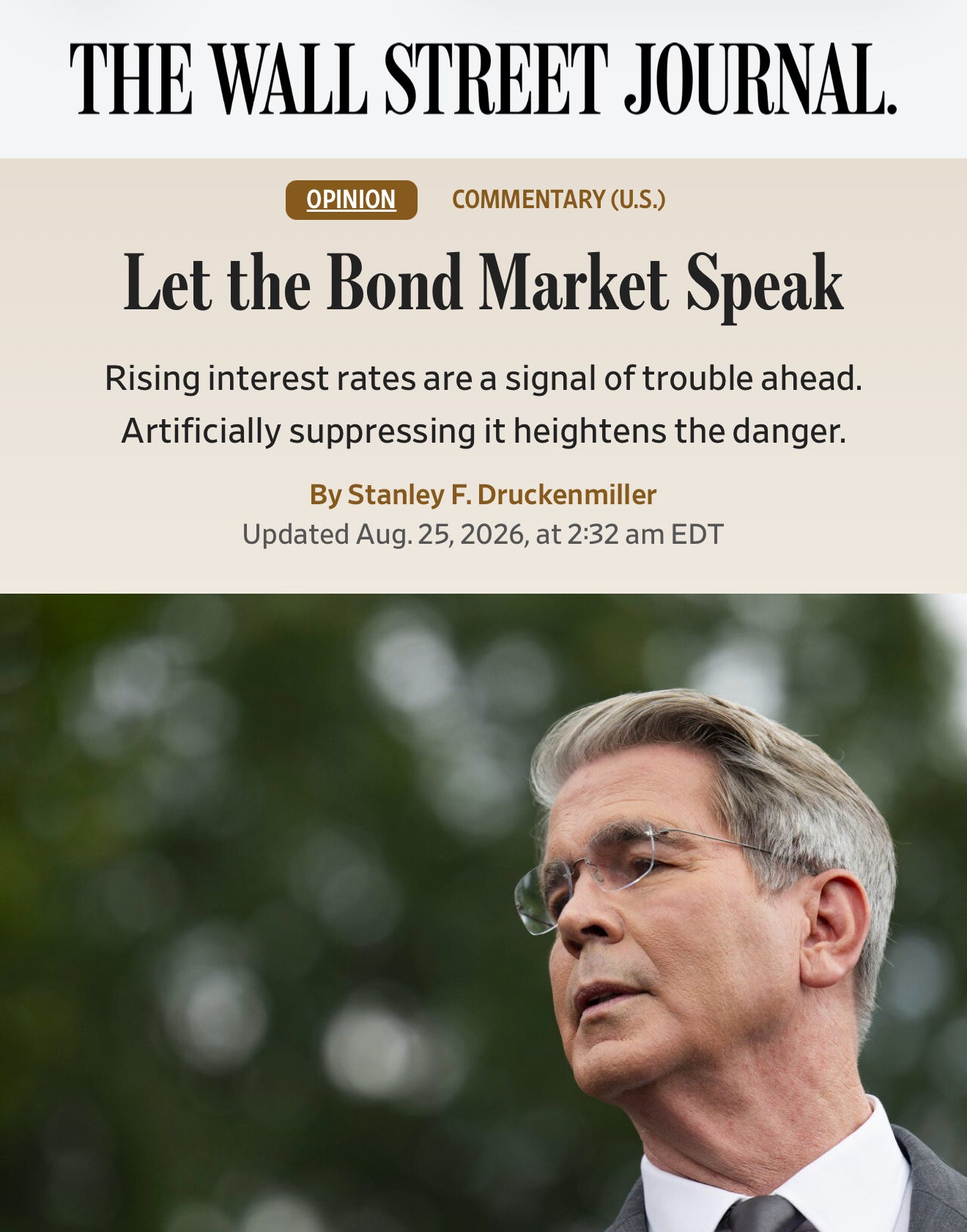
The content of the piece was good. Druckenmiller made a strong and persuasive case that the intervention was bad monetary policy and that market rates ought to be what reflects the risk of borrowing. I happen to agree with Druckenmiller here policy wise.
What is the Problem?
Here is the problem… the piece was clearly AI-assisted and/or AI-written to anyone familiar with writing. It had all the telltale signs - “that isn’t a crisis. It is an invoice,” “the defense of the buybacks writes itself… All true but besides the point,” “you can’t buy your way out of a solvency conversation with liquidity tools.”
The internet piled on.
Pangram 100% AI-written score.
Then, Stanley Druckenmiller confirmed it himself, “I write everything using AI now.”
I was pretty stunned by what happened next…
The WSJ editors have stood by their publishing of the op-ed and chosen to keep it published - “Druckenmiller’s Surprising Critique of Bessent Was Delivered With the Help of AI.”
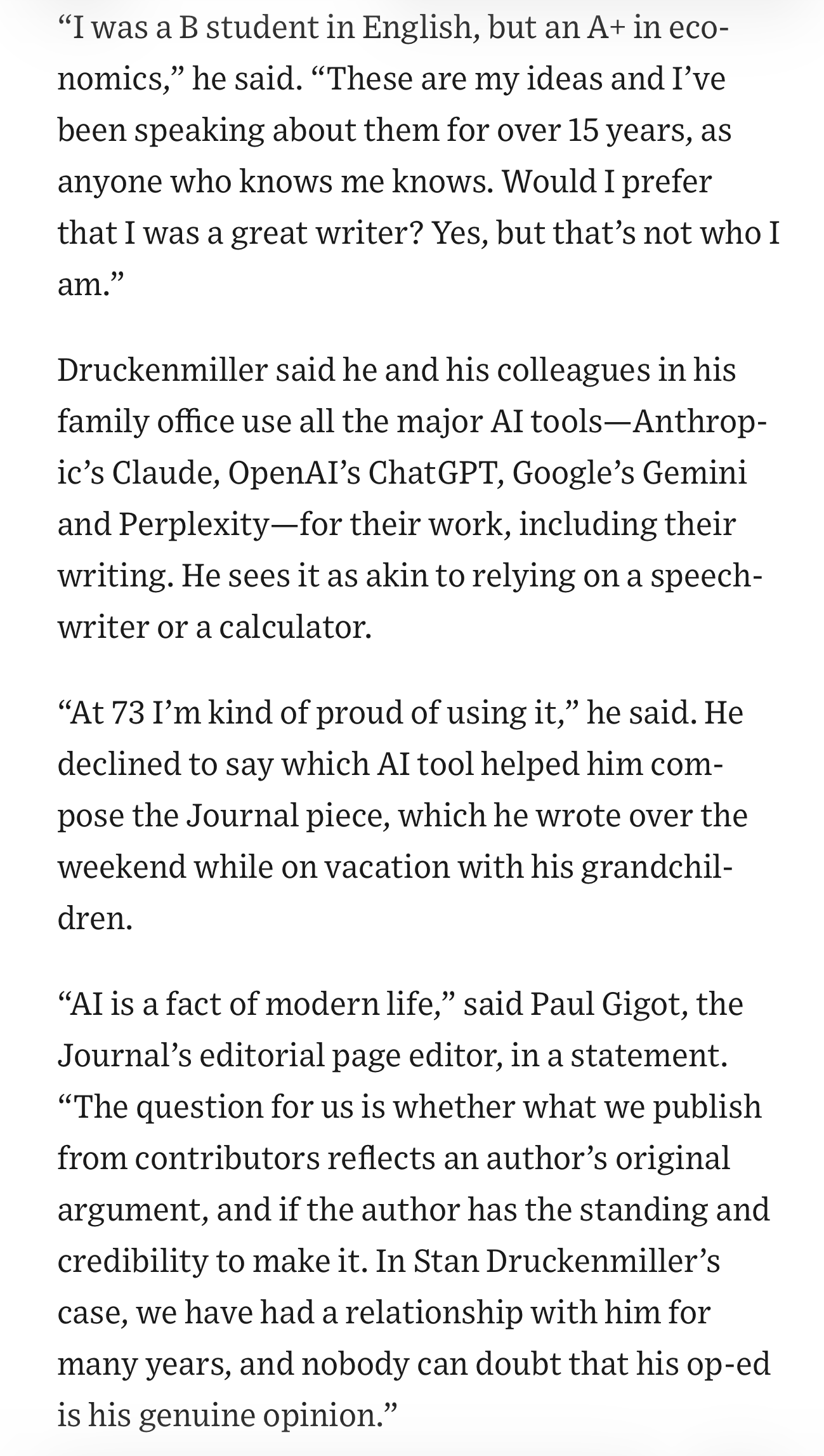
WSJ staff also sent out communications in support of the the Journal’s editorial decision to keep the op-ed published:
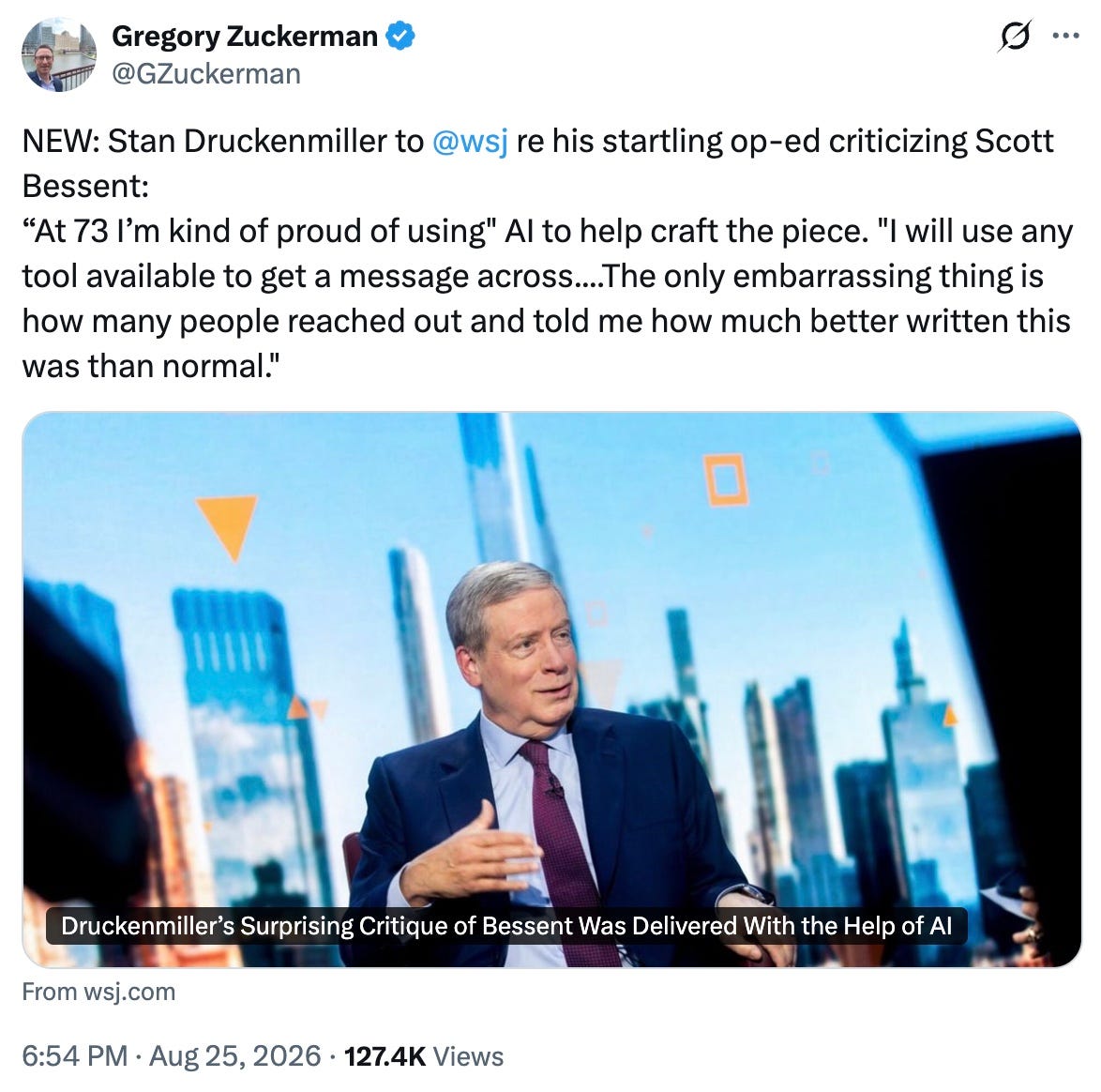
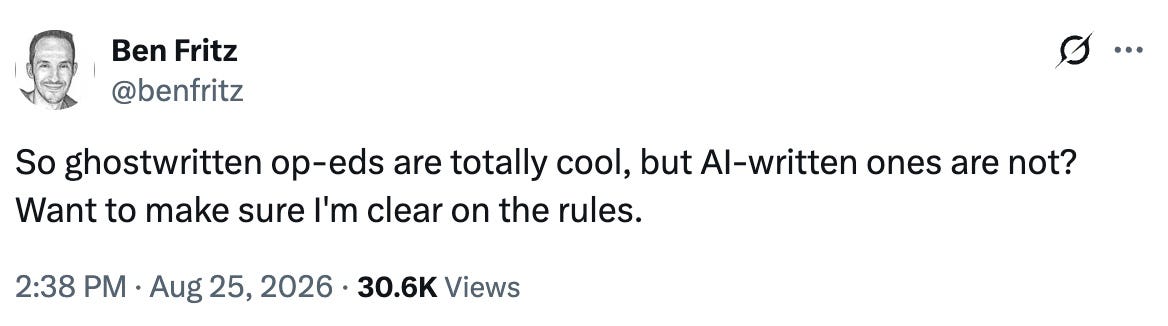
Alright, got the context now?
I understand why people might say, ‘give the 73 year old fund manager a break, he isn’t doing anything anyone else all the busy people in his office aren’t doing.’ I understand why WSJ Ben Fritz brings up ghostwritten op-eds too (that is also a problem).
WSJ Concern
My concern in this matter lies primarily with the WSJ editorial page director (Paul Gigot) decision to keep this op-ed published online:
“AI is a fact of modern life,” said Paul Gigot, the Journal’s editorial page editor, in a statement. “The question for us is whether what we publish from contributors reflects an author’s original argument, and if the author has the standing and credibility to make it. In Stan Druckenmiller’s case, we have had a relationship with him for many years, and nobody can doubt that his op-ed is his genuine opinion.”
This decision is indefensible for three reasons:
By what standard will you judge future publishing decisions?
In a time when accelerationists argue that AI-writing helps the little guy with gatekeepers, this actually structurally reinforces more gatekeeping.
Prompting isn’t writing.
By what standard will you judge future publishing decisions?
The WSJ editorial position argument is that, “The question for us is whether what we publish from contributors reflects an author’s original argument, and if the author has the standing and credibility to make it.”
If this is the new editorial standard at the WSJ, then any contributor should feel completely free to use AI so long as the it reflects the author’s original argument. I am really not sure how you would make these judgment calls in future editorial decisions. It seems extremely subjective and likely to go very sideways.
As if this editorial position wasn’t bad enough, there is a second half to the argument that leads me to the second point…
In a time when accelerationists argue that AI-writing helps the little guy with gatekeepers, this actually structurally reinforces more gatekeeping.
Look back at Gigot’s logic, “and if the author has the standing and credibility to make it.”
I have been inundated over the last two years with AI-accelerationists making the argument that the AI-writing era will finally democratize publishing for all the people out there who are mediocre writers or who have been shut out by all those mean publishing gatekeepers.
I am not a great writer. I am mediocre at best. I am a project manager and institution builder who has a few thoughts. Public school failed me in English/Language Arts in middle school on a lot of the basics of English grammar. I still am fuzzy on a lot of the rules. I am literally learning the rules right now as we homeschool our kids. I use passive voice too much. I write like I talk. I don’t even proofread these substacks half the time, before I hit publish (and my many editor friends cringe). I found a very hard time getting anything published in the middle of my career. If there is anyone who could benefit from AI-assistance, AI-editing, or AI-writing it is someone like myself.
But listen to what Gigot is saying — the author needs to have the standing and credibility to make it. So, you can have AI do your writing as long as you are already a known entity with standing and credibility. Read that again and ponder the implications. The WSJ is telling you that you can use AI in your writing with them as long as you have already been let through the gate. This is the exact opposite of the argument that AI-accelerationists have been making. It will have the opposite of the democratizing effect that they have claimed.
If this standard is adopted across other journalistic outlets, then it will both increase the frequency of AI writing and it will make gatekeeping even more pronounced.
Prompting isn’t Writing
I have saved my best and most important argument for last — prompting isn’t writing.
I absolutely love being a dad. Anybody who knows me in real life knows this. I am the guy who will pull out my phone and show you pictures of my kids without you asking. I have found myself this year spending more time with my kids as we are experimenting with homeschooling them this year. Why do I bring this up?
There is something about parenting and education that gets you straight down to common sense brass tacks.
Let’s ask a few basic questions that every parent and schoolteacher must ask:
Would I let my kids plagiarize?
Would I let my kids pay someone else to do their writing for them?
Would I let my kids turn in an essay that they merely prompted into existence?
No, no, and no!
As I am sitting here typing, I am genuinely considering if I even need to support why for the purposes of this piece. It seems axiomatic to me that any responsible parent must give an emphatic “no” to all three questions. I feel like I am taking crazy pills if some other parent disagreed with me here.
If we would never let our kids do these things, then I am genuinely wondering why we would ever think it is okay for fully formed adults.
I am not sure how teachers and professors around the world are going to be able to hold the line on these things when serious institutions like the WSJ will let billionaires phone it in.
I really don’t know what to say to you if you think that prompting is writing. It just isn’t. You will never convince me that by typing a few sentences in the zero shot and then maybe some follow ups in turn two and turn three that magically you have written a thing. I don’t care if you trained the AI on your entire corpus. I don’t care if you prompt was amazing. I don’t care if the output was consistent with your ideas or brand. I don’t care if the writing was better than your analog voice. PROMPTING ISN’T WRITING. You didn’t write that and I am not willing to pretend that you did.
Writing involves reading.
Writing involves real-world experiences.
Writing involves thinking.
Writing involves writing.
Writing involves a social contract between the writer and the reader.
You cannot be a good writer without being a good reader first. If we allow ourselves to cut corners on our writing, this has huge implications for the future of reading and literacy. I am not saying we will become illiterate but we are in danger of becoming post-literate — namely, a species that has little to no appetite for full length books. If you don’t think that is a problem then you can hit the unsubscribe button or just close this tab.
You cannot write without real-world experiences. AI has no living body. AI has yet to have a “world model” either. AI has no experiences. AI has no stories. It can make statistically generate linguistic facsimiles of stories but it cannot write stories and it has never experienced a story. This means that AI cannot tell you a single story that is both true and unique.
Writing involves thinkg. It is inherently cognitive. You cannot cut corners on your writing without cutting corners on your thinking. You will never convince me that someone has done more thinking who has prompted writing into existence than someone who has written every word. Let’s be crystal clear here that AI writing involves less thinking. The more that AI writing proliferates the less actual thinking has taken place. We just need to be honest with ourselves about that. How did Descartes prove that he existed again… ? Cogito ergo sum…
Writing involves writing. I cannot believe I have to type that sentence. Again, crazy pills…
Writing involves a social contract between the writer and the reader. When I read something from someone, I have historically assumed that they wrote it. I am not interested in reading AI writing. I don’t care about how good it may or may not be. I am simply not interested in it. I am interested in what other humans think based on the sum total of their particular ideas, feelings, and experiences. I have no interest in reading the Gaussian linguistic average of pre and post training data regardless of how good it becomes. For me, these things are theological. Only humans are made in the image of God. No machine will ever be made in the image of God. I am interested in what humans have to say with all of their flaws, quirks, tastes, errors, or idiosyncrasies. AI-writing, in whole or in part, breaks the social contract between the reader and the writer. And by corollary, it breaks the trust between the reader and the institution publishing that writing.
I genuinely hope that the WSJ changes its mind and its policy here. I would welcome and celebrate that.
I think this particular situation needs to bring greater clarity to other editors about where they stand and where they draw their lines.
I don’t think we can give these early journalistic tests a free pass.
I think we need to be more honest that the future of reading, literacy, thinking, and writing is on the line.
Your social contract point is a great one.
I feel your frustration. I don’t use AI to write articles, books, or course materials. I forbid it in my classes and in the student Substack I manage for my university.
And yet I think prompting is a form of writing. Nor do I think I am taking crazy pills for thinking so.
Authorship, when studied closely, is a complicated concept. There are direct forms of authorship, like your article. But there are indirect forms of authorship, too. These span a wide spectrum, from dictating to institutions claiming ownership of writings. AI prompting is on this spectrum. It is a form of indirect authorship.
That doesn’t make it ethical to use in every situation. But it also does not mean every use of AI to write is unethical, either. The challenge is forming the moral imagination to discern which is which.