

Way Too Long Preamble
This weeks piece is a significant pattern interrupt in terms of length and looking at the AI landscape from a layman’s economic perspective. I am primarily writing this piece because I have numerous people in my life who have been asking for a historically and economically informed primer on the AI infrastructure buildout. Those requests have grown over time and have finally eclipsed my many caveats about actually writing this up. Frankly, I am writing all this up so I can save my thumbs all the long texts and I can have a single link to send people. Also, I don’t do the paid subscription thing. I write for the pleasure of it and for the benefit of others, so if you found value I’d appreciate earning your free subscription and sending this on to a friend or two who’d find this piece interesting.
I shouldn’t have to say this but if you are new I will remind you, there is no AI writing in here and I don’t hardly read these things over - so you will frequently find typos, poorly written sentences, and other very human artifacts. I both apologize for that (sorry to all my editor friends) but I also treat this more as a feature than a bug in our era of AI slop.
I am also writing up this econ heavy piece because I don’t think you can have a grasp on what is happening in AI apart from having a working knowledge of the increasingly complex and fragile fiscal ecosystem. The invisible hand of the market is perhaps the single most powerful force shaping the worldwide future of AI. While the cone of uncertainty remains very wide on the future of AI, a failure to have a working economic understanding here could be problematic from a predictive standpoint on any number of disciplines including not just macroeconomics, investing, or business decisions but also implications that spill into epistemology, ethics, theology, education, policy, and sociocultural considerations.
A Ton of Caveats
I have hesitated to write this piece for several reasons:
I hope that I am wrong and would prefer to be wrong
The cone of uncertainty on what happens next in AI is really wide
Because of #2, I would characterize what follows as being speculative and highly subjective
I don’t like to be speculative and highly subjective in my writing
I don’t normally write with a bent towards economics
I am not 100% certain that I have all the data right because there are some approximations that I have tried to note
I won’t be the least bit bothered if you disagree with any part or the entire thing here. There are plenty of good and empirical reasons to be bullish on AI infrastructure. I would love to hone my own thinking here so I invite dialogue of all sorts.
There are Questions Surrounding Worldwide Daily AI Token Revenue
I have been watching the Silicon Data LLM Token Expenditure Index decline for several week now. This index is a “daily benchmark for large language model inference token prices across different providers.”
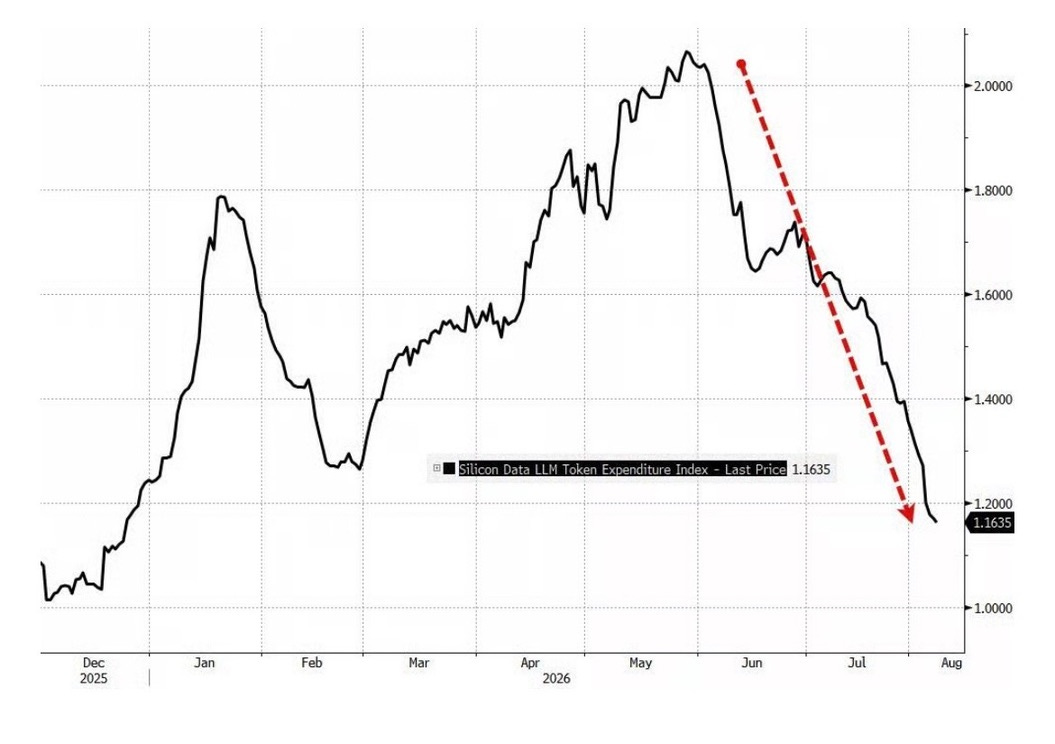
This graph is essentially answering the question, “how expensive is it, on average, to run 1 million LLM tokens today?” When you combine this daily price data with data on inference expenditure x estimated inference volume, there are real questions regarding revenue. Admittedly, there isn’t great data on estimated token volume and the best approximations come from tokensperday.com and Epoch AI / Exponential view). If we put these data set together you can make a very crude estimate on daily AI revenues. To be clear, I think there are substantive methodological problems with combining these data sets as I am not confident in the comprehensiveness nor veracity of them. That being said, I am unaware of any better available data:
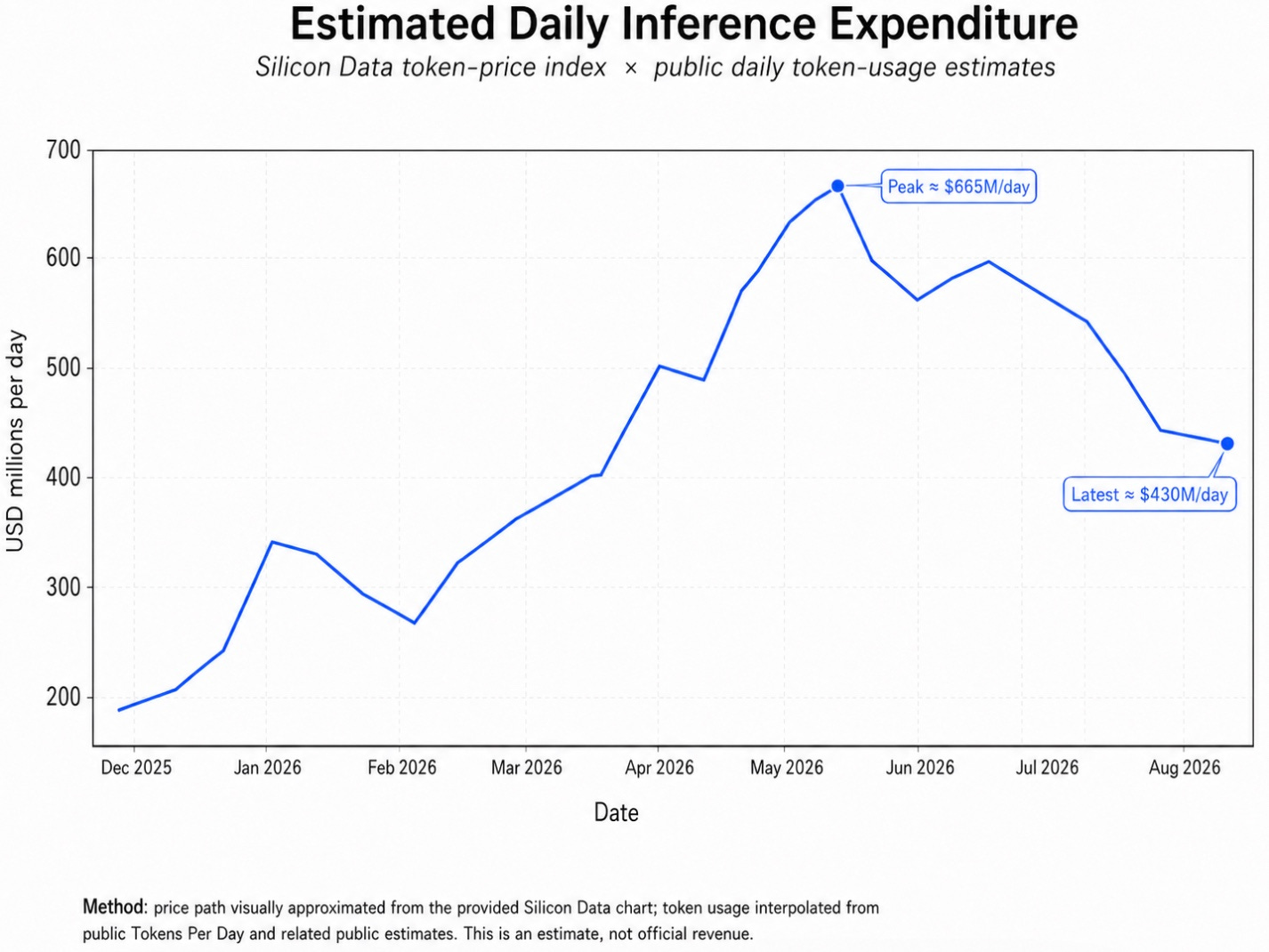
If (and that is a big “if”) the data from both Silicon Data LLM Token Expenditure Index and Tokens Per Day are correct, there are real questions about deceleration or even decrease in total daily AI revenue. If you think this data and methodology is garbage, I am totally fine with that, just try to read the rest of this essay as a lot of stands without any of these guesstimates. Related to this are publication dates of several open source Chinese models:
Qwen 3.6 plus - April 8
Kimi K2.6 - April 21
DeepSeek V4 Preview - April 24
MimiMax M3 - June 1
GLM 5.2 - Mid-June
Kimi K3 - July 16
Qwen 3.8 Max - July 19
DeepSeek V4 - late July/Early August
There are two variables to consider here:
How many tokens are used per day
How much a token costs
It is possible that the agentic AI era causes token usage to explode faster than the unit cost of a token. If so, then revenues will accelerate again. However, if token prices drop faster than token usage rises, then total revenues will continue to decline.
There will be over a trillion dollars in AI infrastructure capital expenditures (capex) in 2026. As best we understand it OpenAI will have about $25-30b in 2026 revenue and Anthropic will have $35-50b in 2026 revenue. Assuming we go with the high end of these projections and impute $80b in 2026 revenue this is a lot of capex with not a lot of revenue behind it. One might quibble here and say we need to add all revenue from all other LLMs, image/video generation… etc. These things are very tricky to model but are probably in the net total of $125-175b range. So, we have maybe $150b in total worldwide AI revenue chasing over a $1t in AI capex and where there does seem to be some evidence (see above) that revenues are actually decelerating.
It is logically possible that the AI infrastructure buildout in the US was forecasted in a way that didn’t anticipate the proliferation of a lot of open source/weight/model AI, especially from China and for pennies on the dollar.
What happens if the revenue projection forecasts were significantly off and we are just now noticing?
Why 1873, 2000, and 2008 Might Rhyme with 2026-2027
The answer can be found in a mixture of history rhyming with 1873, 2000, and 2008.
1873 isn’t one of those years that just comes to the front of mind but it is an imporant year. It is the year there was a massive financial collapse surrounding the rapid expansion of railroad infrastructure in the United States, especially transcontinental rail. Estimates vary, but railroad capex could have been around 6% of GDP and the projected future revenues from rail ended up being much higher than reality, especially after grain prices fell and freight volume didn’t scale up fast enough. The result was a significant amount of defaults and a dramatic reset in the winners and losers in trains in the US.
2000 is the year most people recall when they think of the dot com bubble bursting. The timeline is straightforward with 1998 to March 10, 2000 being the speculative boom. Rightly so, investors understood that the internet was going to change everything, and it did. The problem is that this doesn’t mean that every website was going to be a huge winner and we now know that most of them would eventually go to zero. Panic and the first round of liquidations took place from April to November of 2000. Then waves of massive insolvency and a recession followed in 2001. Hundreds of dot-coms close up shop, the country enters a rececession, and the NASDAQ loses 78% of its value from peak to trough from March 2000 to October 2002.
2008 is definitely seared more into recent memory for anyone who is now millennial or older. The Great Financial crisis began with a housing bubble fueled by subprime mortgages. Those garbage mortgages were packaged into complex financial instruments called “mortgage backed securities” (MBS) and “collateralized debt obligations” (CDOs). The teaser rates on adjustable rate mortgages end up resetting to their higher rates and mortgage defaults rise rapidly. In early 2007 you see some subprime lenders become insolvent, then Bear Stearns goes under, France’s largest bank (BNP Paribas) freezes funds. Come September 2008 Lehman Brothers files for bankruptcy and Fannie Mae and Freddie Mac enter conservatorship and Wall Street collapses in panic. It takes 6 months for the market to bottom, Congress passes the $700b TARP bailout, and the Fed cuts interest rates to near zero.
So, what do 1873, 2000, and 2008 have to do with 2026-2027?
No one situation maps super cleanly, but they all partially relate in a way that makes you feel like history is rhyming.
With 1873, you have a massive piece of crucial infrastructure needed - railroads. Those railroads were needed for both personal and commercial usage. The buildout was a massive 6% of GDP (note this three times the 1.8% of GDP for 2026 US AI infrastructure buildout ($581b/$32t est. 2026 US GDP). The projected future revenues from the railroads exceeded the actual revenues and this caused cascading debt defaults and dramatically changed who the winners and losers in railroad would be in the US. AI infrastructure is similar in that it is critical, has widespread application, and is a significant portion of GDP.
With 2000, you have a truly world changing technology that brings humanity to an inflection point in the internet. There is no doubt that there will be billions made on the internet with huge rewards for whomever can become digital king of the hill. All of this eventually came true but not until speculation was rampant and valuations unhinged from reality. AI infrastructure is similar in that it is a game changing technology that will change and remake the world but we have yet to sort out who the winners and losers are yet in the tech stack.
With 2008, you have well intentioned financing on something important - home ownership. Those good intentions go sideways when we forget that assessing risk in underwriting is crucial to the stability of the market and when you dramatically loosed or even flagrantly ignore all standards, then buyers flood the market and prices blow up in an unsustainable bubble. To make this scheme possible you create complex financial instruments that hide the garbage and then you have ratings agencies certify it as fresh. AI infrastructure is similar in that you have unprofitable borrowers in startups like OpenAI and Anthropic that cannot afford the compute that they need/want so they deploy increasingly creative tactics to acquire the capital needed. At first you can trade equity for compute but then you only have so much equity to give away. Then you can take on debt for compute but then lenders keep raising interest rates commensurate with default risk and then maybe nobody will lend to you anymore. Eventually you end up with complex circular financing deals that map like this (and even this map is a little old):
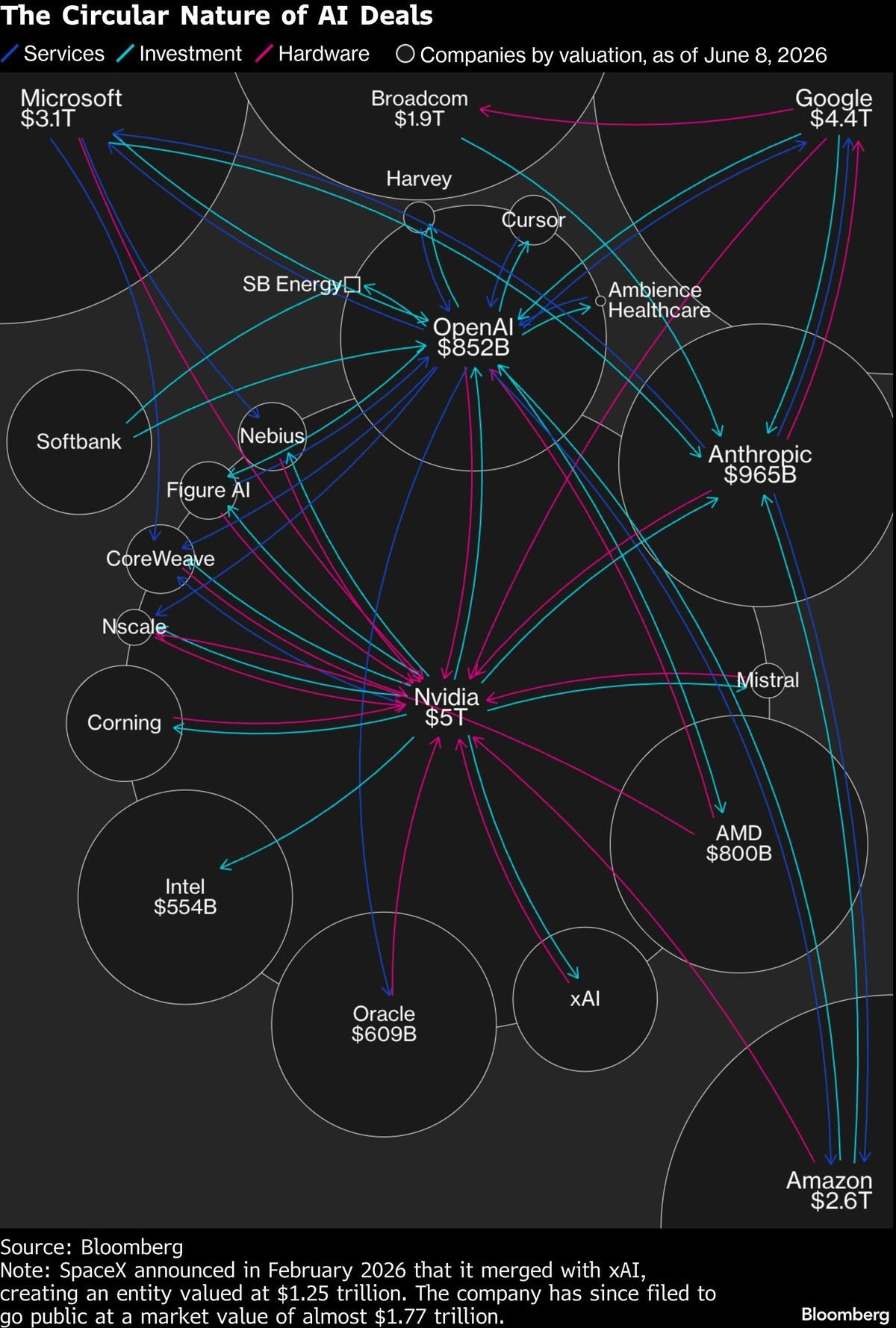
It is important to note that in 2008 financial institutions were leveraged 30:1 on extremely toxic assets. The current situation does not have nearly the same amount of leverage on nearly as problematic of an asset.
How is AI Infrastructure Being Financed?
There are at least four main ways that AI infrastructure capex is funded and each of those main ways has several sub-genres:
Hyperscalers FCF and Augmented Debt (~55% of total 2026 AI capex) - behemoths like Google, Amazon, Microsoft, Meta, and Oracle who take profits/free cash flow (FCF) and use their own money. More recently some of this has also begun to be financed through debt (typically corporate bond issuances).
Private Capital (including all private credit, asset/GPU backed financing, and securitization - ~30% of all 2026 AI capex debt) - deals like the $500b MOU between Nvidia and a number of firms like Brookfield, KKR, Blackstone… etc. - these deals happen now because Nvidia knows that the foundational models are struggling to get the cash needed to buy compute but Nvidia needs people to buy their silicon, so they go and try to shore up the liquidity needed to keep it all going. These deals are primarily for “neoclouds” (CoreWeave, Nebius, IREN… etc.) who don’t have the same FCF to subsidize the structures, land, and power required for their data centers. This money comes in wide range of capital between instruments like private credit, infrastructure equity, pension money, asset-backed loans (collateralized GPUs/land… etc.), securitizations (more GPU collateralizing… etc.), structured leases, offtake agreements, and a few other instruments (insurance… etc.). Offtake agreements require a bit more explanation. If you are a Fortune 500 business who doesn’t own your own data center(s) and you want AI integration in your business then you are essentially stuck “renting” AI from one of the hyperscalers who are hosting some of the foundational model. Many businesses want to make their AI workloads budgetable line item so they enter into a multiyear contract with a hyperscaler(s), model maker(s), and/or sometimes bundled pair. Offtake agreements buttress approximately 30-40% of this category of financing. Bookmark this mentally as we will return as to how this could go sideways for both hyperscalers and model makers if Fortune 500 companies decide to “own” their AI instead of “rent” their AI.
Financial Engineering (Circular Financing/Vendor Financing) (~10% of total 2026 AI capex with about 5% of that being purely circular and about 5% being JV debt)- imagine you are in the business of making expensive lemonade stands but your friend wants to start one but doesn’t have the cash to start one up. To accelerate your business you lend the $1,000 needed to start your friends high end lemonade stand but the catch is the lemondate stand must use that money to buy your lemonade startup product. Your friend decides they want to start more lemonade stands and a bank agrees to lend them money to do it but to do it the bank requires the actual lemonade stand to be placed as collateral. You get your money today but your friend takes on the debt and has to pay off the new loan over time and as the physical lemonade stand wears out (i.e. depreciates) over time. Sometimes these deals also involve the giving out the lemonade stand infrastructure in return for an equity percentage in the new lemonade stand venture. In this imperfect analogy a chipmaker like Nvidia will lend money OR trade equity to foundational models (like OpenAI or Anthropic) in return for them buying their GPUs. Nvidia wins because they are able to realize revenue immediately OR they can show in their earnings growth in rapidly appreciating valuations of their ownership in AI-startups whose valuations are skyrocketing. When they no longer want to lend to a particular model maker they simply assist in the handshake with a lender and the lender then collateralizes the GPUs. The risk is passed off to the AI model maker and the financial institution. The technical terms for this particular schema are strategic/vendor equity, offtake guarantees, GPU-backed collateralized lending, and off balance sheet leases (JVs - this is like Meta creating a third party vehicle that builds/owns a data center and Meta signs an exclusive 15-20 year lease/usage contract and the third party vehicle can borrow against its lease with Meta - this keeps debt off the books). Put a mental bookmark here as we will explore what happens how this financial engineering can go sideways in just a minute.
Sovereign Wealth Funds (globally this is ~5% of all 2026 AI capex debt) - many countries have concluded that AI infrastructure is critical infrastructure analogous to electricity, water, or national defense. We have seen countries like China, Saudi Arabia, UAE, and others pour tens or hundreds of billions into AI infrastructure with the understanding that their future geopolitical positioning will significantly hinge on being on the bleeding edge of AI. Sometimes the sovereign wealth funds end up with a mixture of sovereign wealth mixed alongside private capital as well.
Three years ago financing AI infrastructructure was straightforward - Microsoft earns money from business operations and buys GPUs.
Now things are much more complex - Anthropic/OpenAI signs B2B long-term compute contract and that contract supports a third party company (typically a special purpose vehicle) that in turn buys GPUs and builds a data center who in turn pays rent from its revenue to the lenders who financed the whole deal.
This makes the work a lot harder for silicon companies like Nvidia because they cannot just make GPUs anymore, they have to invest in the tenant/operators, guarantee compute capacity, and help financially engineer the lending schemas required for adequate liquidity.
What Could Go Wrong?
There are a number of ways that these four financial methods can go sideways and I want to sketch out a few weaknesses with each method before addressing systemic risks:
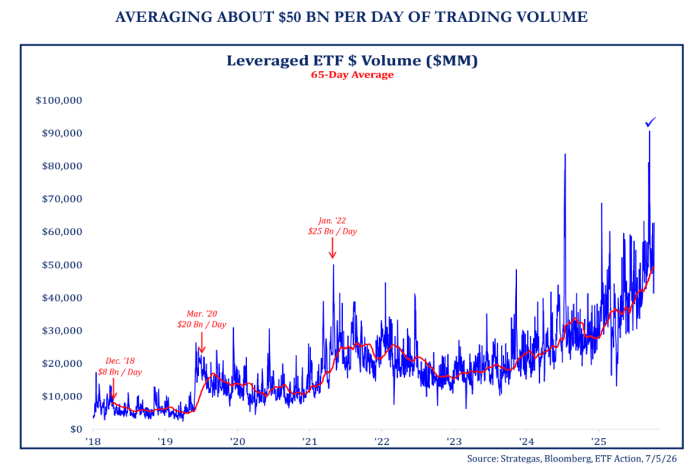
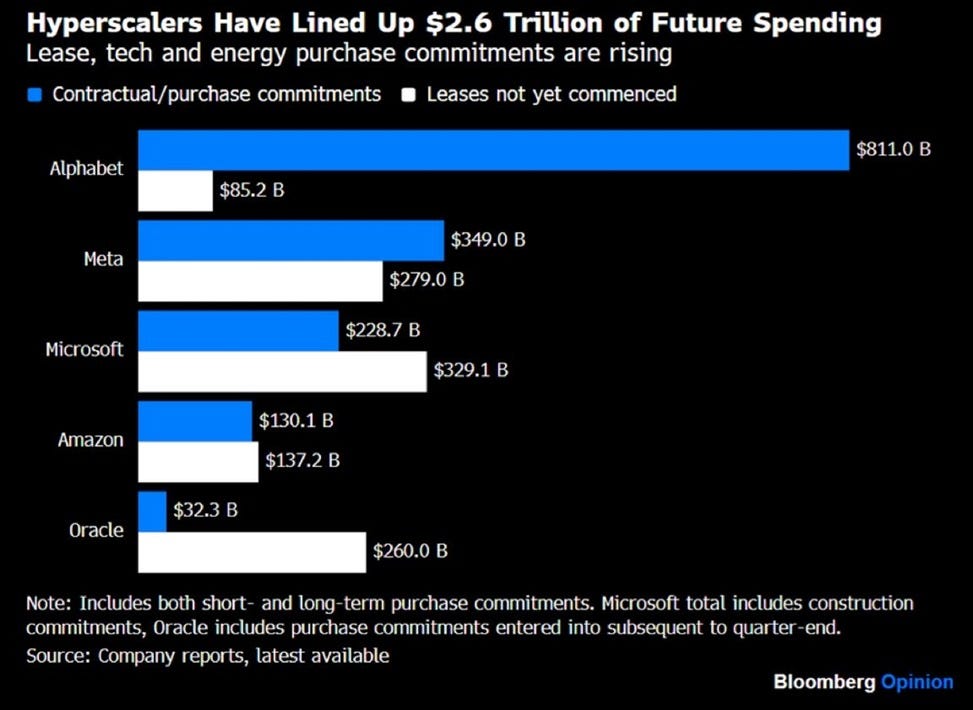
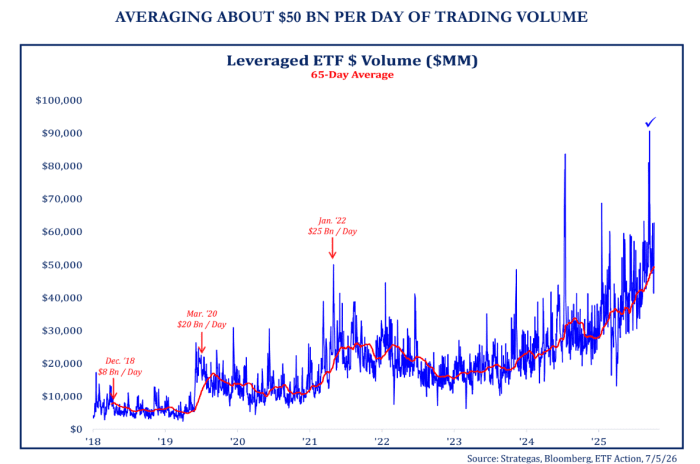
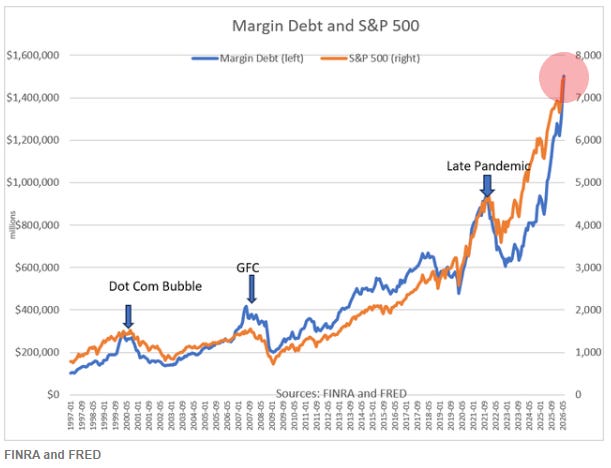
Hyperscaler FCF/Debt (~50% of capex) - prima facia this method of financing is the least problematic because it is simply pre-existing extremely profitable companies plowing their profits into something they think will have high ROI cash flow. The corporate bond issuance is a bit of a nuissance to shareholders and they might ding the stock a bit. But here is the problem, if the return on invested capital (ROIC) isn’t as high as projected then it hurts their future earnings. When those earnings come in lower than expected and/or lower than forward guidance, then the stock price will fall. One might say, “who cares if these behemoth tech companies stock prices come down a bit?” Well remember what the dominant financial advice for regular folks (retail investors) has been for a decade - “just buy the index (“VOO and chill”… etc.). The problem here is that some 40-45% of the indexes are primarily tied into AI infrastructure. Exposure roughly breaks down like this - S&P 500/SPY (30% primary), NASDAQ Composite (40% primary, and QQQ (48% primary). Those numbers go even higher if you account for companies who secondarily relate to AI infrastructure. So, if major companies like Google, Amazon, Microsoft, Meta, and Oracle start to have disappointing earnings or cancel data center contracts then retail and institutional balances are going to take a major hit. This dynamic could be further exacerbated by record amounts of leverage (trading on margin, leveraged ETFs, leveraged individual stocks). One can observe the recent lessons learned in South Korea when a few headlines caused the unwinding of leverage in their index that is over 50% reliant on two memory companies (SK Hynix and Samsung). When highly leveraged assets lose value quickly it can trigger cascading margin calls that spread fiscal contagion. Say a company like Oracle has taken on way too much off the books debt (see image below) and you begin to see the default swaps on the company get more and more expensive due to over-reliance on agreements with OpenAI. Say their stock begins tanking hard and fast but you have leveraged bets on the company and you get margin called, you then have sell other assets to come up with the cash to pay for your margin call. Maybe you sold something “boring and safe” like United Healthcare or Chlorox or an index ETF like SPY, QQQ, or VOO… but now those stocks and indexes are infected with Oracle’s contagion due to elevated leverage:
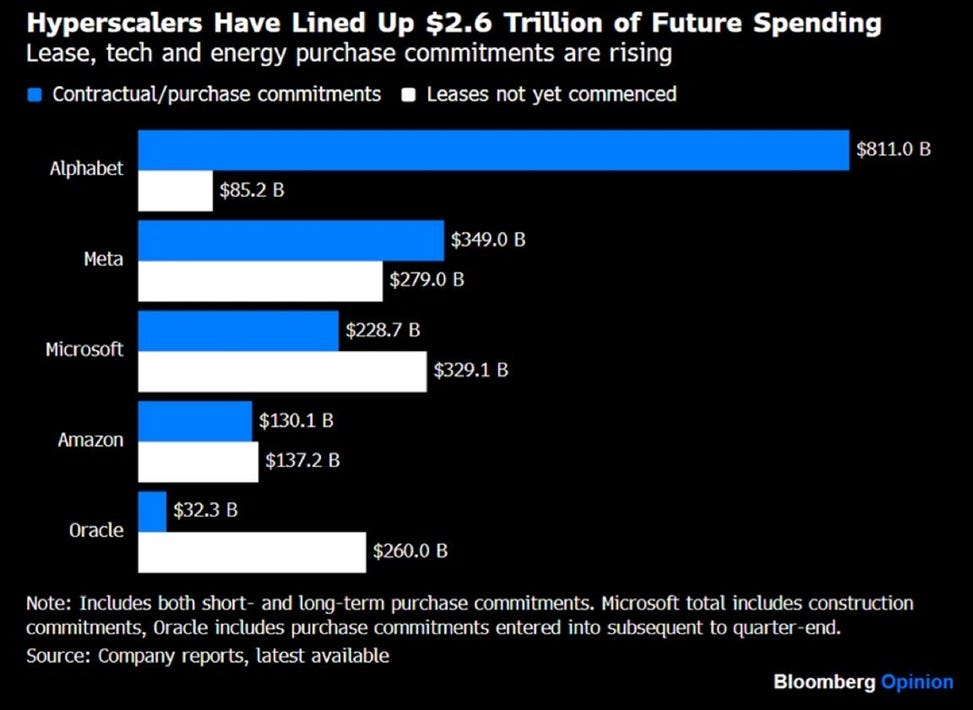
(Leases not yet commenced only appear in footnotes on corporate financials and sometimes can obscure the overall debt picture and this may be part of the reason why credit default swaps on Oracle have hit an 18 year high)
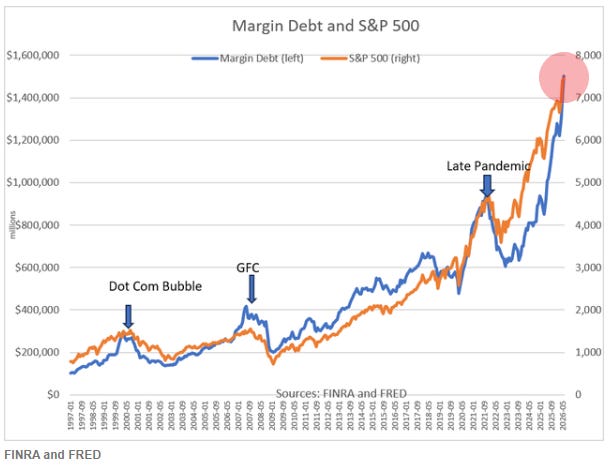
So, the big risk here is that the markets are heavily correlated with AI infrastructure and any problems in the narrative OR in actual earnings could cause a painful and potentially violent unwinding. As it stands I will gladly concede that the earnings have largely been there but those earnings are largely downstream from an era where financing was more straightforward and growth in foundational model ARR was growing rapidly. In my view, the TTM and NTM earnings multiples on memory and storage companies justify their current valuations even if they begin to level off in the 2028-2030 time frame.
Private Capital (~30% of capex) - the biggest problem that I see here is Fortune 500 companies decided to “own” their AI instead of “renting” it. Take for example Eli Lilly who have decided to treat AI like a proprietary scientific instrument instead of software to outsource. Instead of expensive long-term offtake agreements they just build their own data center (LillyPod). They make sure that all their IP, clinical trial histories, chemical structures, and other sensitive corporate data remain exclusively on their cloud. They can use whatever open weight model they want or build their own custom one and run infinite tokens with the only expense being electricity and the overhead of the GPUs and data center. Initially Nvidia doesn’t care if they do this because LillyPod is full of their GPUs but the neoclouds, hyperscalers, and OpenAI/Anthropic all lose because Eli Lilly owns LillyPod instead of renting cloud compute from them and purchasing tokens from OpenAI or Anthropic. The proliferation or free or pennies on the dollar “good enough” open weight/model/source AI is only going to continue and these models will only get better. Further, the lag time between when OpenAI or Anthropic publish a new “game changing” model and when those model weights have been distilled by open source models will likely continue to compress. The problem is that while initially Nvidia might not care if Eli Lilly owns their AI instead of rents it but it does hurt them because the ecosystem is highly correlated where if these B2B AI ownership trends become writ large then a neocloud bankruptcy, Oracle financial woes, or deceleration in revenue growth at Anthropic/OpenAI could have cascading implications. More on that highly correlated ecosystem in our concluding macro risk assessment in a minute.
Financial Engineering (Circular/Vendor Financing + JV Debt) (~10% of capex) - the entire circular financing structure depends on continued revenue growth and ideally growth that is accelerating from the foundational models like OpenAI and Anthropic. When they grow their annual recurring revenue they can buy more compute which keeps grease on all the fiscal gears. If the revenue growth decelerates - or worse the revenue itself declines - then they can’t purchase as much silicon and less JV, SPV, neocloud, and hyperscaler deals and data centers get done. The primary concerns here are margin compression and price/token primarily driven by less expensive AI options.
Sovereign Wealth Funds (~5% of capex) - this is probably the least of the financing concerns being that it is the smallest. I think any existing or aspiring world superpower will need to have significant spend on AI infrastructure to be taken seriously both economically and from a power/security standpoint. All sorts of potential military and socio-political and economic game theory scenarios will need to be played out and whomever has more powerful AI will have asymmetric advantages. However, this area is not without some tail risk. Let’s say that things get really bad and the AI infrastructure story falls apart in some significant way and both OpenAI and Anthropic are in serious financial danger and maybe even talk of bankruptcy. In such an event it is entirely plausible that a current or future administration would make an argument that these models are a key part of our tech, national security, and economic infrastructure and develop an expensive plan to salvage, save, prop up, invest, or maybe even nationalize those model makers. In that scenario there would have already been all sorts of pain on Wall Street that would have brought us to this expensive policy decision. However, in order to finance a tech bailout (that would probably also include bailouts to all the financiers as well) you would need to of course print more money and expand the national debt. Doing so in turn increases yields on treasury debt which in turn causes more money to flow out of stocks. At this point there is a good chance we are in a recession too. I am not saying this scenario is base case - it is not. This is a logically possible tail risk scenario.
Core Thesis
Alright, so I have deeply buried the lede on my core thesis:
Because the AI infrastructure ecosystem is incredibly highly correlated, any failures in execution could have very significant economic fallout and then be followed by cultural, policy, and geopolitical implications.
Here are a few systemic threats or execution failures that could dramatically damage the ecosystem:
Anthropic and/or OpenAI revenues underperform projections - In this scenario the entire ecosystem is deprived of water needed for everything in the entire system. Less GPUs. Less data centers. Less memory. Less power. Less revenue. Less profit/earnings. Stocks go down, cost of new debt goes up, and risks of defaults become elevated.
GPUs depreciate faster than expected - let’s say new generations of AI chips drive down cost/token faster than what had been previously modeled. In such a scenario older GPUs were supposed to have more “life” left in them than what was expected. Normally, you would say, “great, these new chips are amazing, fast, and efficient.” The problem is all those older Nvidia chips are now depreciating faster than expected but they were collateralized AND securitized to have certain lifetime revenue expectations that they can no longer meet. This could have some SPVs default on their debts and private capital might take a big haircut on all those asset backed securities. This likely hurts the neoclouds like CoreWeave, Nebius, IREN, and others and the might not be able to derive the revenue to meet the debt service coverage ratios. If I am in private capital, what do I do with GPUs that I just repossessed? So, maybe a neocloud or two goes belly up or has to dramatically restructure their debt. Or maybe Mark Cuban is right that some of the data centers become pickleball courts… (I don’t actually think this but it was humorous on Cuban’s part).
Private Capital Tightens Lending - What happens if lenders decide to only lend 50% loan-to-value (LTV) instead of 80% LTV? What happens if lenders increase rates from 6 or 7% to 10% on AI debt? What if they decide to only do 6 year amortizations instead of 10, 15, or 20 years? What happens if credit for contracted revenue goes from 100% down to 70%? All of these scenarios end up tightening liquidity and that will negatively impact every single player in the entire AI ecosystem.
Hyperscaler margins get squeezed - we have already seen capex explode for hyperscalers like Google, Amazon, Microsoft, Meta, and Oracle. They have almost all run out of FCF to finance their capex so now they are doing corporate bond issuance. The market has been patient so far with this trend because the Street si forward looking and is still largely believing that there are massive high margin profits to be found in cloud compute. But what if cracks begin to form in that story and in Wall Street sentiment? In that scenario if you are a hyperscaler scenario you have a tough decision to make. You can either A. Be a true believer that the profits will be there and the capex is justified and be willing to take the short-term hit on your stock price and pain inflicted by bad press and upset shareholders B. Cut capex and be rewarded OR maybe not penalized as much as your choice A peers. If we see hyperscalers begin to cut capex then there is likely to be a significant repricing of every company in the entire AI infrastructure trade. I don’t know if a single hyperscaler cutting capex would be enough of a catalyst to trigger a protracted unwinding and selloff but maybe two consecutive quarters of lower capex by a plurality of hyperscalers would be enough of a catalyst here.
Electricity and Land Issues - let’s say everything is humming along and just about everything in here is baseless hand wringing. Let’s say we have record compute backlogs and memory is sold out into 2028+. What happens if we cannot get a enough data centers built and enough electricity to those data centers? We have already seen increased friction even in red states to new data centers. Many states now want to see all kind of new guarantees before approving anything. There is an awful lot of growing NIMBYism as well. Further, there are a lot of parts of electrical infrastructure that are quite inelastic. There are specific transformer and other chokepoints that don’t have quick and easy solutions. Even more, it isn’t simple or quick to just build whole new power plants. This scenario is not the worst scenario for AI infrastructure because it means the demand and profit are there but the whole ecosystem might not grow as fast as expected because electrical and land issues are slowing down the buildout. There is an alternative scenario here where electrical and data centers are overbuilt. This doesn’t seem likely in the near-term future given the compute backlogs. But there is a tail risk scenario where token efficiencies grow much faster than expected and AI really solid models can run on your desktop, laptop, or even smartphone. In that scenario AI workloads could increasingly migrate from the cloud to on-device inference for lighter reasoning workloads. This scenario would hurt lenders, REITs, utilities, GPUs, neoclouds, and hyperscalers. This scenario would only be good for companies like Apple and Qualcomm.
Sovereign Wealth Issues and/or Nationalization Scenarios - a number of the scenarios listed above could lead to countries salvage, save, prop up, invest, or maybe even nationalize parts of the AI infrastructure. As previously noted, this would lead to more sovereign debt globally which begets rising interest rates which begets outflows from stocks into fixed interest vehicles. It is possible that there could also be geopolitical situations where nation states like Saudi Arabia might pull out of AI infrastructure deals that aren’t in Saudi Arabia. This would draw additional liquidity out of the system that if not replaced would also have a decelerationary effect.
Businesses Don’t See Enough Gains - many CEOs have noted that they have yet to see appreciable fiscal, operational, or efficiency gains from increased AI usage and expenditure. The implications here are obvious if they decrease spending - the whole ecosystem loses.
China Invades Taiwan - Taiwan Semiconductor supplies 90% of the worlds silicon. It has been rapidly diversifying its fabrications facilities outside of Taiwan. There is one in Austin and there are two more in Arizona that are slated to come online in late 2027 and 2030 respectively. There are other fabs elsewhere in Asia. However, over 90% of Taiwan Semiconductors output currently comes out of Taiwan (with over 95% of their AI relevant wafers coming from Taiwan) and total output is likely still over 80% occuring in Taiwan by 2030. Simply put, there is no AI without Taiwan Semiconductor. They are an even bigger chokepoint than memory and storage. A Chinese invasion of Taiwan would cause immediate shocks to every market worldwide. It would be biblical.
The scenarios I see as being the highest probable are 1 & 3. We will find out a lot more about scenario 1 when we see the SEC filings associated with Anthropic’s IPO scheduled tentatively for late September or October. The Anthropic IPO filing might be the single most scrutinized set of financials in human history because of how much money is riding on the success or failure of the AI infrastructure story. On scenario 3 we are starting to see debt rates rise on some of the new offerings. This is concerning because those deals are typically not publicized but the financial institutions are able to conduct fiscal due diligence that the public is not privy to. The implication is if rates are rising it is because risk is on the rise and the people who have the best look at the hard numbers as saying risk is rising.
A lot of the other scenarios are less plausible or even tail risk but I think they are all reasonable things that could play themselves out.
I worry that history rhymes with 1873, in that we have too much of our GDP riding on the success of one unproven industry.
I worry that history rhymes with 2000, in that we have this amazing new technological frontier but we haven’t yet sorted out who the winners and losers are in the tech stack.
I worry that history rhymes with 2008, in that the financing of a sector gets so complicated and convoluted that it obscures the actual underlying risk and the potential fiscal contagion.
The cone of uncertainty remains wide. AI infrastructure will be built in the US. There is no doubt about that. AI is probably the single most powerful and transformative technology to date in human history. My questions pertain to timeline, winners and losers, margins, funding vehicles, and ultimately total addressable market, revenue, and profit. The history of paradigm shifting technologies with significant up front infrastructure costs is shaky. There are many possible futures here and there are many reasonable scenarios that could usher real pain to the fragile ecosystem. If so, the impact will reverberate well outside of Wall Street with difficult to predict implications for many aspects of culture and society.
Thanks, Michael. The AI market may see a correction (most new, rapidly hyped markets do), but the long-term fundamentals remain unchanged. The rapid drop in the cost of intelligence is too compelling for capitalism. Companies in competitive markets will be compelled to keep up, with much greater long-term costs to our economic system than a short-term bubble. I'd love to see you discuss this in a future article.
I am impressed by the clarity of your thought. The message still is clear. AI is here to stay. We are overpaying for a massive infrastructure which will have far lower ROI than anyone can comprehend. This is not because there will not be compute demand, it will be because the cost for this demand will be far lower than what is projected.
If AI is to succeed, the most definite outcome is the French Revolution of the 2020s. The massacre of the ultra rich is inevitable.